Monday, December 5, 2011

Pach's Real Talk: Amnesia - The Dark Descent

Greetings game-Oh my... oh my god are you ok? Jesus, sit down... can I get you anything? You look like you just ran a mile, you're covered in cuts and bruises, and your hair is starting to fall out. Just... just relax and tell pachy what happened. Wait, Amnesia? You played it ALONE?! Well... you know what they say about poking a sleeping bear with a stick.

Real talk.

Look, we've all been there. We've all been horribly emasculated before. It comes in all shapes and sizes ranging from accidentally calling your teacher "mommy" in 4th grade to having that one chick give you the "don't worry, it happens to everybody, I'm sure you're just stressed out" talk. Well F*** YOU DEBBIE MAYBE IF YOU DIDN'T LOOK AT JOHN THAT WAY WE COULD HAVE MADE IT WORK. WE. COULD. HAVE. MADE. IT. WORK. Oh god....

Wait what was I talking about?... Ah, yes. Whores. And Amnesia.

Before we get started let me just say that I am a horror game/movie enthusiast. Now, I'm not talking about slashers and gore and virgins (because who REALLY likes those anyway?), I'm talking about good old fashioned theatrical horror. The kind of stuff that makes you scream and want to stop watching... but is so compelling that you keep coming back. The kind of stuff that has you shouting at the television or cuddling some random nearby object with the hopes that it will turn into something that loves you. Entertainment at its most basic level is there to elicit an emotional response from an audience, so to me the horror genre is incredibly important because it controls two of our most important emotional responses: fear and courage.

First, I think it's important to note what makes a "bad" or "unmemorable" horror experience, and then we'll talk about what makes Amnesia a truly incredible horror game.

Bad horror games or movies always tend to have the same things in common:
1.) They tend to overuse quick scares and shocks
2.) They tend to very much abuse special effects (in the case of movies) or extremely over the top weapons and gore in the case of games.
3.) They tend to not have very accessible scenarios or plots
4.) They tend to go for the cheaper hooks such as sex, offensive/explicit content, or stupid addons like multiplayer and survival modes.

What does all this mean? Well lets break down a few of those for a minute here... just to better understand where I'm coming from. Lets say you have a very young sibling (for the sake of argument lets say little sister) and you happen to be a very, very cruel person. Not too hard was it you psychopath...? But anyway, you want to really, REALLY scare the crap out of her. You have two options: You can either don a monster mask and garb, wait for the moment she's going to bed, and leap from the closet to scare her OR... you take her whilst she is asleep, lock her in a strange, dark basement or toolshed with no windows, and then when she wakes up make torture noises from outside for a few hours.

What's the difference there? Well you're probably thinking "One makes you an ass in her eyes, and the other puts her in therapy for 5 years." But why? Both don't actually cause any physical harm to her, or put her in any actual danger, but what's the difference? The difference is imagination. The human imagination is a terrible, dark, demented place filled with killer bunnies and midgets covered in peanut butter. With the immediate jumping out of the closet method, you blow your load all at once. She may jump or even scream, but then she see's that it's just her dickhead sibling and her mind relieves the stress. With the basement method, you allow her terrible imagination to dream up all the most horrible, painful, vile explanations to what is going on, and then force her to KEEP imagining until you let it stop. That is the difference. Whenever the imagination is allowed to do its sadistic duty, we as creative thinkers tend to put ourselves in FAR more peril than we may actually be in. Being afraid isn't about being logical and seeing something as scary, being afraid is about being irrational and imagining the worst case scenario for your demise.

Now, this is not to say that the "monster jumping from the closet" tactic doesn't have its fair share of uses. It can be VERY useful if put in the right circumstance. But going for the low-hanging fruit on a regular basis can cause the audience to get numb or detach from the experience. Which brings me to my next point: gore and weapons. These things can be the kiss-o-death for any horror experience if used incorrectly.

While one might immediately think "Seeing blood and guts everywhere is really scary!" That is never the best way to get the response that one wants from a horror game. A horror game is all about stress relief management. Let me say that again: stress. relief. management. In most "horror" games there is a fairly simple formula that designers tend to use when creating a scary experience. They put you in a scary place with scary blood and guts, then something scary comes out and scares you in the scary place, then you murder that scary thing and move on to the next area. They stress you out with immediate danger, and then when you solve the problem you go back to neutral waiting for the next scare.

Using poor stress relief management, games will stress you out with a monster that bursts through a window, or a random scream here or there, but once you get past it you realize that it was just your annoying brother in a mask.

However, with a true horror game, your stress doesn't go in peaks and dives. Your stress is a constant build. Every step further that you take puts you more and more on edge, and even when you deal with whatever antagonists the game has in store for you, you STILL don't feel any better. We've all played games with poor stress relief management... Dead Space, Doom, Fear, Condemned, etc.

Now, you may be thinking "Hey bro, dead space was supes scary! I jumped like a little girl the first time those things came out of the vents!" Well. I'm sure you did. The FIRST time. But by the twentieth vent, I'll bet that you didn't jump nearly as high, or scream nearly as loud. In fact, I'd wager that you didn't really react at all beyond the reflexive need to survive. I'll bet by the 50th mutilated baby or torture victim you probably became a little bit numb to the whole situation. That's because gore and direct violence do NOT make for a complete horror experience. We are never afraid of someone getting killed in front of us in a game, we are afraid of coming into a room knowing that tons of people HAD been killed there.

Put yourself in the protagonist's shoes and tell me what's worse: A monster jumps out, he spooks you, and you dismember it with your laser crossbow or shotgun to the joys of its screams and blood spattering the walls... OR A monster jumps out, you have no weapons so you grab the nearest pipe, you struggle with it, barely escape with your life, and realize "Holy god, it's still out there somewhere... waiting for me." Yeah. Have fun sleeping tonight.

The final point I'd like to make about bad horror games (before we get to sweet, sweet Amnesia) concerns the situations that designers put their players in. A lot of times we assume that putting players in a scary place, such as a bloody space station with aliens, or an abandoned military base with demons, will somehow assist the players in making an emotional connection to the game. But lets think about this for a second... what makes a player connect? Well one of the primary things that makes human beings connect to one another is empathy, or the ability to relate to one another and their experiences.

If a player can't put themselves in the shoes of the protagonist to a certain extent, or if they can't empathize with the hero's plight, the player tends to tune out a lot of what goes on from moment to moment. What I'm getting at here is: I can't remember the last time I was a super soldier with the ability to control time, trapped in an abandoned military base forced to fight my way through hordes of mutants and demons with my M4 and flashbangs... but I can remember a time when I've been alone in an abandoned hotel after dark, or trapped in an elevator, or stuck in a shady subway station with no cell phone, or been in a house that someone was trying to break into. It's that human connection that makes a horror game truly stand out as a memorable experience.

Which brings me to Amnesia - The Dark Descent. This game breaks all the formulas one expects from a horror game, and defies all expectations. Not only that, but it does so without ANY over the top blood and gore, or ridiculous shock tactics.

You begin the game not as a soldier, or an ex-cop, or a dude in a super suit, but as a guy. Just a normal guy. A normal guy who has seen some ****. Seen so much, in fact, that to keep from going crazy he drank an amnesia potion to forget all about it... all but one crucial thing: get to the bottom of this castle/mansion and murder an old man waiting for him down there.

So as you might expect you start off in a castle just after drinking this cocktail of brain melting goodness. There are no weapons, no power ups - just you, your balls, and your masochism to get you down to the bottom of this elaborate place. There is only one catch. Yeah, that terrible stuff that you wanted to forget about? Well... it's following you and trying to murder the crap out of you.

Alright, now without giving away any spoilers, lets get down to the awesome.

The protagonists' name is Daniel, a name you'll probably be screaming over and over again like a death scene in a bad action flick as he runs from one place to another (DANIELLLLL RUN YOU PIECE OF COWARDLY **** RUN RUN RUN RUN DANIEL DANIEEEEEEEEL). He is constantly being pursued by a "shadow" that takes the form of different monsters and just generally messed up things. Ok, actually that sounds pretty standard, right? Nothing too out of the ordinary for a scary video game, right? Wrong.

First of all, there is a special catch to the monster's presence in the game. By looking at it, your character slowly starts to lose his god damned mind a la Eternal Darkness. But not only that... by looking at it, it can see YOU better as well. This makes things a little bit complicated since you also have zero means to defend yourself, so your main mechanic when dealing with the monster is going to be hiding and running like a coward. Why is this actually a brilliant and meaningful mechanic as far as horror games go? Well, three reasons:

1.) As tough as we all would like to think we are (bro), the truth of the matter is this: if we were ever confronted with a horrifying monster that feeds on dreams and happiness, we would run, run, and run some more, then hide, cover our eyes and ears, and wait for death. That's just fact. So having the game mechanics tap into our core impulses like that makes for some VERY meaningful gameplay.
2.) Remember when we said stress relief management was about a build as opposed to a burst? What do you do when you have no way of striking back at the force that scared you... no way of punishing the game for making you feel the way you feel? The answer is you reach a level of uneasiness that is very difficult to achieve in a fantasy world.
3.) When even looking at the antagonist in a horror game is bad news, it causes the player to... well... not look at what is scaring them most of the time. Which means that the game is forcing the imagination to come up with a monster far more terrifying than anything the game designers could dream of. It also makes the monster personally catered to you as a player, which is an even more horrifying concept.

Not only that, but the environment of Brennenburg Castle (the place you're running for your life in) is perfectly designed to keep you on the edge of your seat every single solitary moment of gameplay. The lighting effects of the game are top notch, and have been designed to affect the gameplay as much as anything else. Sitting in darkness makes you go crazy faster... but darkness is usually the only place that you can hide from the monster in. Your lantern is your saving grace, and you will find yourself rustling through countless drawers and cabinets trying to find more oil and tinder... just like a real crazy person trapped in a hopeless murder castle would do. Oh... that is if the shadow doesn't blow out light sources as it comes and goes. Yeah... **** that thing.

The sound design brilliantly and subtly influences your every decision as you travel around. A creaking door here, a gust of wind there, a strange whisper (or was it?) and even the sound of your own footsteps all paint a picture of absolute terror for your mind to wrap itself around.

Sound also plays a huge role in the game because most of the time that's the only way you'll know whether or not the monster is coming after you. There is no traditional music in the game other than some ambient noise and tones based on your mental state and where you are, but when the monster comes the music changes to let you know to get the **** out of dodge. But to take it a step further, once the game trains you to respond a certain way to music and sound effects, it starts to mess with you a little bit. Sometimes the monster will show up without music, or the music will continue to play whether he's there or whether he left. While many other horror games develop scare patterns that players eventually get used to, Amnesia takes it a step further and teaches you to not trust your eyes or ears... but your impulses.

Which brings me to my next point: you should never "play" your way through a horror game, you should feel your way through it. A good horror game doesn't have any real patterns and it certainly doesn't let the player come to expect certain things. A good horror game grabs a hold of you and doesn't let go until you turn it off and go pretend like you weren't affected. That is what makes Amnesia so awesome. When you're playing, you're in it, and even when you scream or stop playing it still lingers with you as you go back into reality.

So many times we find similarities between our games and tend to expect certain outcomes for our behavior. You expect that the game will stay the same if you die and revive, you expect that once you beat a boss the game will lay off you for a minute to catch your breath, you expect in many ways that the game is on your side. With horror this is a difficult thing, because for the game to REALLY be on your side, it has to be scaring you and constantly putting you in stressful situations (ideally at a disadvantage), and it must be merciless about it. That's what you bought the game for: to be frightened so badly that you have a visceral reaction to the experience. And Amnesia delivers, every step of the way.

No hardcore weapons, no weird torture-babies, no tentacles, no gore, just good old fashioned theatricality. The ability to mess with a person's subconscious and emotional state of being is what makes any horror experience succeed or fail in the end. Amnesia - The Dark Descent doesn't disappoint. Not only does it not disappoint, but in this humble blogger's opinion it sets a very high standard for the horror genre that will not be met for some time. Every single aspect of this game is a success, and (if you've got the nerve... cause it's totally fine if you don't) I definitely suggest you pick it up.

Friday, December 2, 2011

Sid Meier's Civilization 5: My Adventures - Episode 1

This is a new segment I will be writing from time to time.  For those of you that know me, it comes as no surprise that I am a fan of the Civilization games.  I have poured countless hours into the recent embodiment of genius that is Civ 5, and I have come away from it with more than my fair share of stories, to say the least.  I intend to share these experiences with the general public by way of these posts.  For those of you that have never played any of the Civilization titles: do not be afraid to read on (but shame on you for not playing them!).  This segment will not be jargon-heavy, so those of you that have no knowledge of the series should still be able to enjoy the stories as much as an experienced Civ player.

My Adventures in Civilization 5 
Episode 1:  European Treachery

Pachbel (the same Pachbel who writes weekly for this blog) and myself have played several Civ 5 multiplayer campaigns.  We team up against other teams of computers and try our hands at different victory types.  Right after I purchased the game, we decided to jump right into an online game.  I picked the Chinese, and he picked the Japanese.  Since it was our first time playing the game, we had no real plans on pursuing any particular victory.  We started the game, only to find out that we ended up on continents on the opposite side of the map.  So naturally, we decided that our first objective would be to join our two civilizations in an unholy union of world superpowers.  To accomplish this, we needed to explore first.  Things started fairly slow as we ran around with our scouts to check the surrounding landscape.  However, it wasn't long before I found a World Wonder (in the form of Cerro de Potosi) and was promptly distracted by the riches it promised.  After quickly looking up the purpose of obtaining wonders, I began to try and expand my empire towards the gem-encrusted mountain.  While I was working towards this, I happened upon the esteemed Elizabeth of England.  Excited about the prospect of procuring an ally for our empire, I decided to try an exercise in diplomacy with the English queen.  Of course, Elizabeth wanted no part in anything I had to offer, promptly threatening me with the wrath of the Redcoats should I get in her way.  Not one to shy away from a challenge, I decided to test her resolve (I wasn't about to let her steal Cerro de Potosi) - and she definitely held true to her word.

Off in the Land of the Rising Sun, things weren't going as well for Pachbel (which is saying something, since I was at the brink of war with an angry Brit).  While I was off chasing wonders and hobnobbing with bitter queens, my ally was toiling in misery while fighting off the barbarian horde.  For those of you that have not played the game, barbarians are essentially the trolls of Civ 5.  They never manage to do any real damage to your cities, but if you leave a worker/settler unattended, you can bet that some upstart barbarian gang will show up to snatch that precious citizen right out of your hands.  This also applies to leaving a low health military unit out in the open, or leaving a city without the protection of at least one capable defender.  Whenever you're vulnerable, the Barbs will find a way to troll you.  They'll burn every tile improvement you have, kidnap any unprotected worker they can find, and pick off any low health unit that doesn't have support, and then simply leave your lands to go troll someone else (or perhaps start 4chan) - presumably while listening to this song the entire time.  Barbarian camps also work like the heads of the mythical Hydra.  If you incinerate one camp, two or three more will spring up to take its place.  By this point in the game, Japan had not one, not two, but SEVEN barbarian camps surrounding it from all sides.  Needless to say, things were not going well for Japan - leaving me without allied support against England.

Barbarians:  the epitome of wit and elegance.


Without the help of my allies on the other side of the world, I was going to have to find a way to hold off a British invasion with my currently undermanned Chinese forces.  This was when I discovered the beauty of the devastating Chu-Ko-Nu.  For those that don't know, the Chu-Ko-Nu is China's version of a crossbowman.  However, comparing a Chu-Ko-Nu to a normal crossbowman is like comparing an atomic bomb to a cherry bomb.  The former destroys nations, while the latter destroys toilets.  I had a whopping two of these deathdealers to hold off the entirety of the British army, and I was able to do it with ease.  The crossbow volleys were too much for the cranky Elizabeth, and so the Red Coats retreated - with my army suffering nothing more than a single death.  Her majesty retreated back to her own borders (which were touching mine at this point) to regroup.

Elizabeth was not aware of this universal truth.
 

It was at this point in time that I was introduced to the noble Napoleon.  The Frenchman apparently hated the Brits just as much as I did, and he was more than eager to ally against them, IF I provided him with an open borders treaty.  I should have found it suspicious that the diminutive general happened to have 10-12 troops stationed right outside my borders before the treaty was signed, but I dismissed it as him providing me with assistance against my British oppressors.  I was about to find out one of Civ 5's life lessons - never trust Napoleon.  Sure enough, the French wasted no time flooding my borders with their troops, all under the guise of helping in the fight against Elizabeth.  A few moments later, Napoleon promptly revealed his ace in the hole - allying with the Brits and attacking my cities from within my own borders.  I was now holding off invasions on two fronts from two European superpowers.  My Chinese empire was in serious trouble.

At this point you might be saying: "Hey Boston, where the hell is Pachbel's Japanese army?" Sadly, I was wondering the very same thing.  Japan had indeed finally broken through the Barbarian blockade, only to find that the two of us were separated by the majority of the ocean.  Upon being told of my plight, Pach sent a few contingents of Samurai to help me in the war effort.  Sadly, the war would most likely end before the majestic swordsmen even reached their destination.  Having just broken free from his barbarian rulers, it was at this time that Pachbel decided to do what any emperor would have done in his situation - he set out to find things to murder.  Japan embarked on a mission to take over the entirety of the Southeastern continent.  This started with the systematic obliteration of anything that even resembled a barbarian camp.  After that task was complete, Pachbel set his sights on any and all nearby city-states.  City-states are just like civilizations, except they typically only have a single city.  They are mostly used as pawns to supply your empire with resources or soldiers.  Hardened from the dark ages of barbarian oppression, Pachbel ignored the potential usefulness of the city-states and began to take over each and every one he could find.  The city-states fought hard, but the might of Japan was just too much for them to handle, and Pachbel soon found himself the proud owner of 6 new cities - spread all across his continent.  However, the Japanese bloodlust had not yet been sated.  Pachbel only hungered for more, setting his sights on Gandhi's India.  Gandhi replied by declaring war on us, but this didn't deter Pachbel one bit.  He wouldn't be stopped until every Indian city was flying a Japanese flag.

Sorry Gandhi, but "peace" isn't on the menu. 
We can definitely do the tempura though.


Back over in my neck of the woods, I had successfully managed to destroy most of the French invaders and roughly 2/3 of the British army.  At this point, Napoleon did the very thing that the French do best - he retreated.  Stationing half my troops at home to protect my flank from the feisty Brits, I began my Occupy France campaign.  The difference between Occupy France and Occupy Wall Street is that my campaign didn't involve tents and homeless protesters, it involved me hunting down anything in a blue coat and making them wish they'd never screwed with the Chinese.  After chasing the French halfway to their capital, I had begun to think that I may have been a little over-zealous.  I sent my troops to regroup back in my cities.  Thankful for the reprieve, Napoleon retracted his declaration of war and requested a proclamation of friendship.  With my crossbow-wielding death machines in tow, I was still feeling good about my ability to hold off any invasions, so I accepted the proclamation.  After seeing that I was now friendly with France, Elizabeth signed a peace treaty.  Things were now fairly quiet on the Chinese front, so I began to expand my empire wherever I could find useful resources.  My science score was also getting fairly high, so Japan and I were pumping out technological advancements like nobody's business - shooting us ahead of the competition by leaps and bounds.   Would this prove to be our rivals' crucial mistake?

Over in the land of the Japanese Crusades, Pachbel had convincingly conquered India.  With Gandhi out of the picture, he set his blood-hazed gaze upon his new target: the Persian Empire, led by Darius the Great.  Until this point, Darius had never bothered with the Japanese, but that didn't stop Pachbel from attacking the noble Persian with his battle-hardened Japanese army.  This war lasted several decades, but eventually Persia would fall to the swarm of samurai and cannons at Japan's disposal.  Having completely dominated his own continent, Pachbel decided that he would finally make the long-awaited trek across the ocean to pay a visit to my empire.  His small Samurai contingent had already made their way to my side of the world, but they had been distracted by the prospect of conquering yet another city-state, so they never managed to make their way to my borders.  I was faring quite well at this point though, as I was able to rake in large amounts of money and resources while at peace for the first time in ages.  My army was also quite sizable, and I had a technological advantage over all of my rivals.  Elizabeth was too intimidated to actually try and attack me at this point, but that didn't stop Napoleon NaTROLLeon.  True to his nickname, the warmonger suddenly requested that I open my borders to him again.  Not one to fall for the same trick twice, I refused.  This angered Napoleon, but not enough to declare war.  I decided to send a unit of fast-moving cavalry to scout my borders.  Sure enough, there was Napoleon's army, preparing for yet another invasion.  I repositioned my defensive troops to block his entry into my domain.  Upon reaching the blockade, the foolhardy Frenchman declared war - charging at me with everything from Musketeers to Cannons.  Unfortunately (for Napoleon), my technology was more advanced than the French had anticipated, and I wiped out half of the invasion without suffering a single casualty.  Napoleon's French instincts took over again, and he retreated back to his homelands.

"I'm also great at starting fights I can't finish"
- Napoleon


It was tempting to back off and continue to advance my civilization as best as I could, but I had my fill of this backstabbing Frenchman.  Knowing that the Japanese would be there to protect me from an attack by the English, I moved the majority of my army to the west to do what I should have done ages ago - track down and destroy the French empire.  Elizabeth, ever the opportunist, saw my attack on Napoleon as a chance to grab some French cities of her own.  She promptly declared war on the Blue Coats and set off for Paris.  Pachbel's army had arrived on my borders around this time, and had begun positioning itself in a defensive posture around my cities.  Knowing that Elizabeth had left her borders relatively unguarded, the battle-hungry Japanese began to salivate over the prospect of seizing some British land.  Pachbel and I agreed that we could wait until Napoleon had been dealt with before we decided on Britain's fate.

When I arrived in France over to the west, Napoleon had mustered up a pathetic defensive line as a last ditch effort to dissuade my invasion.  I vaporized the defenders in moments, making them nothing more than a speed bump on my road to Paris.  I set upon the first city in my sights, taking it over with little effort.  I stationed a defensive garrison inside my first French city, and aptly renamed it "New Beijing." I set upon two other outlying cities, taking them as easily as I had taken the first.  Once I had properly garrisoned those cities, I had caught the scent of freshly-baked French baguettes.  I followed my nose and finally laid eyes upon Paris.  I decided to take my time and explore the French empire before committing to the siege of the capital.  As I expected, Elizabeth had already taken two southern cities, and was marching her troops over to Paris.  I was not going to let the Brits steal my thunder, so I redirected 7 troops to cut off the English soldiers - prematurely ending their celebratory champagne drinking.  I arrived just before the Red Coats and promptly surrounded the French city.  Just before his capital fell, I received a peace treaty request from Napoleon.  Sadly, my hearing was damaged from the cacophony of mortar-fire, and the warmonger's plea fell on deaf ears.  I proceeded to take Paris while the British watched.  Elizabeth did not appear to be phased by this, but she was also likely intimidated by my military prowess.  After I secured the once-French cities with adequate defenses, I started my long march home.  Knowing that the English were doing the same, I managed to edge ahead of their march, preventing them from reaching the English borders.  The Japanese were stationed around two English cities, and I had successfully surrounded the entire British army out in the open.  I'm sure you can guess what followed.

Wow, I can smell that delicious French Chinese bread from here!


If you guessed that we had several tea parties with the queen while we reminisced about Napoleon's traitorous behavior, you'd be wrong.  We set upon the British with the ferocity of a pack of wolves, and there was nothing that Elizabeth could do.  We quickly laid waste to all her outlying cities, making our way towards London, Elizabeth's last bastion of hope.  The combined might of the Chinese and Japanese armies was just too much for the English queen, and she fell just as all our other opponents did, as we rose from the ashes in triumph.  We had successfully conquered the world.  However, this was not the end for Boston and Pachbel, so stay tuned to The Little Gaming Blog to hear about our next adventure.  Happy reading!

Tuesday, November 29, 2011

Design Chat: Fallout 3 and Fallout: New Vegas

And now for something completely different!

Here is the The Little Gaming Blog's first design-focused post (hopefully it's the first of many).  For my initial foray into design discussions, I decided to start out with two games that have provided me with hours upon hours of entertainment:  Fallout 3, and Fallout: New Vegas.  I'm going to cover them as one collective game because: both are run on the same engine, and both are very similar outside of their respective storylines (and the few changes/additions that came with New Vegas).  Without further ado, let's get started.

VATS:  The VATS system (Vault-Tec Assisted Targeting System, for all the non-nerds out there) allows the player to momentarily pause gameplay to aim at specific parts of a target's body with whatever weapon is in hand.  Once the shots are fired, the player watches the action unfold at almost bullet-time speed (that's "slow motion," for those of you that don't know).  This typically ends in more accurate attacks and the occasional glorious dismemberment. 
Why this was added to the game:  You might not know this, but shooter fans and RPG fans do not always overlap.  You're not going to find a lot of hardcore Counter Strike players lining up to play Skyrim, just like you're not going to find a bunch of dudes dressed up as Cloud Strife playing Modern Warfare 3 at MLG.  Understanding this is the key to understanding why VATS was added to the game: it keeps the game from feeling like a pure shooter.  Sure, there are other reasons for it being there, but without VATS, the Fallout games would look more like Half-Life than Fallout.  Aside from that, the devs also ensured the use of VATS by attaching perks and abilities to it, as well as adding additional functionality as a reward for using the system.  Giving players a reason to use a beneficial (but largely optional) system is always a sign of good design.

  Why go for the 8-ball in the corner pocket
  when you can go for a .38 in the eye socket?


Fast Travel:  Fallout's fast travel system allows the player to instantly travel to a location already discovered on the map, as long as the player is not in combat or carrying too much weight.
Why this was added to the game:  While the designers want the players to see the massive world they've created, there's no need for players to travel through the same empty areas for 30 minutes every time they want to visit Megaton.  Visiting each area once was enough for the developers to allow you to teleport there afterwards.  There's also the possibility that this was added by request of the QA team, after they were exhausted from repeatedly walking across the vast, mostly barren landscape.  In contrast, pay-to-play MMOs do not offer this type of fast travel because they want you to keep playing the MMO as much as possible.  Since players feel the need to play MORE when they are paying for their time, MMOs can get away with this.  Console games are generally expected to offer shortcut systems to cut down on monotonous gameplay, because players are NOT paying for their time.  Therefore, the fast travel system is not necessarily good design as much as it's expected design.  Regardless, it's still a nice addition to the game. 

Companions:  I'm going to assume that everyone reading this post has at least a little familiarity with the games in question.  However, if you're not very knowledgeable about the titles, just know that you can recruit companions during your playthrough.  These companions follow you around, fight with you, and carry items. 
Why this was added to the game: It gets lonely in the desert!  No, seriously, that's one of the main reasons as to why they were added, outside of their attachment to the alignment system.  It's much more comforting to have a companion on your journey, even if it's a giant, yellow, muscle-bound mutant with a penchant for murder (and this is one of the "good" alignment characters, go figure).  The designers also needed to find a few more things to link to the game's alignment system, so that it had value (something that Fable has never seemed to understand).  This comes in the form of alignment-specific buddies that will turn you down if you're not their preferred flavor of evil or wholesome.  The companions have their own set of glitches and problems (especially in New Vegas), but they're still a welcome addition to the game - when they're not running into a group of 20 enemies and getting themselves vaporized or shot to smithereens in the process.  As a parting gift, your "friend" will also turn the attention of every angry thing within a 5 mile radius onto you, usually guaranteeing you'll be meeting your wasteland companion at the pearly gates in short order.

This is Lily, a Fallout: New Vegas companion. 
She says that she's stealthy.  I'll just take her word for it.


Quests:  The quests in the Fallout games do an excellent job of giving you extra incentives to explore a large portion of the wasteland around you.  The designers managed to make the quests feel pretty different from one another, even if you're repeating similar actions.  The key to this is keeping the motivations fresh while throwing in a variety of characters and activities to keep the player from thinking "Oh great, another fetch quest." Oftentimes the player will also be rewarded with a variety of items upon embarking on and finishing quests, making the whole ordeal more than worth their time.  Quests that don't feel repetitive and monotonous for anyone but the most jaded of all gamers?  Good design.

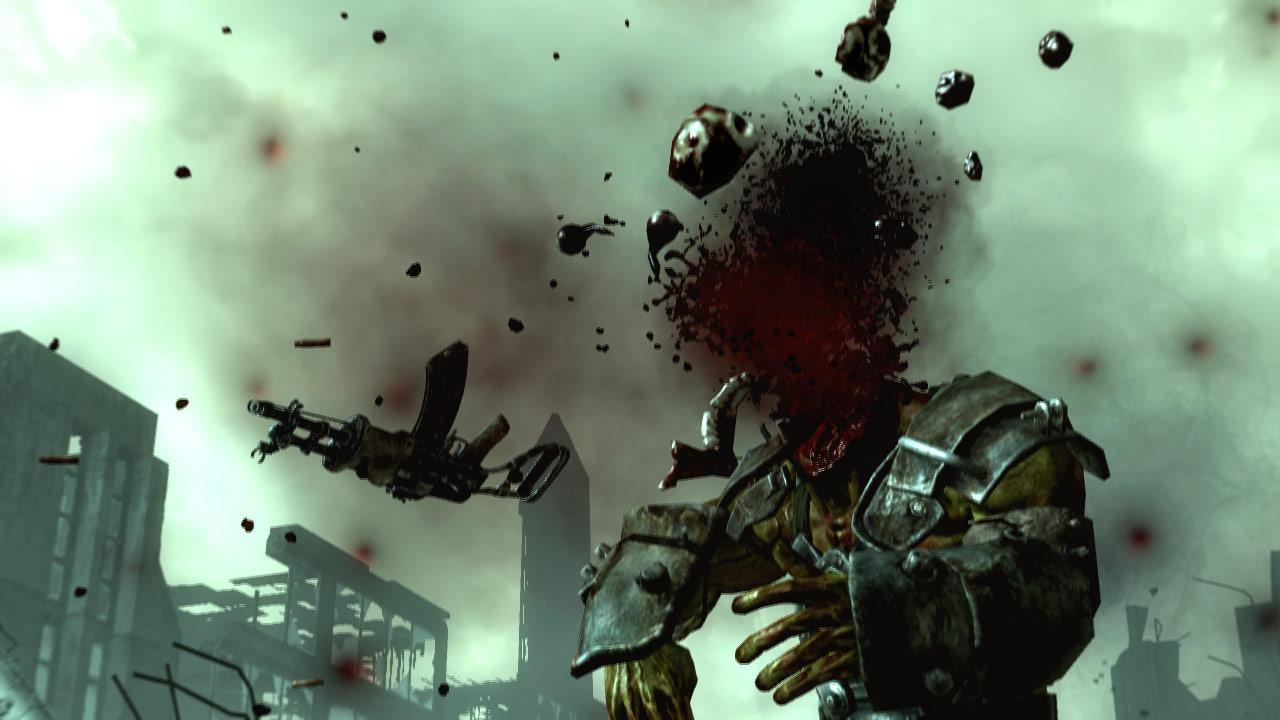
Combat:  The sound and visual effects combine to give the combat system an almost-tangible "substance."  You get a nice 'crunch' when connecting with a melee weapon, and the big fleshy explosions resulting from gunfire definitely feel satisfying when they happen (not in the psychopathic sense, but in the sense that they keep the combat from being mundane).  While it can get a bit gory, it's more on the outrageous side of the gore spectrum (think Kill Bill or almost any anime, where blood/flesh sprays everywhere for no reason), which keeps it from being gross to all but the most squeamish of people.  This 'crunchy combat' is an example of good design, because it keeps repetitive actions from feeling like a chore. Yes, you're still doing the same basic actions over and over, but if it doesn't feel like you're toiling through tedium, then the developers have done something right.


This is not an example of combat. 
This is what happens when a Super Mutant divides by zero.


Customization:  This is a focal point of the Fallout games.  Everything about your character is almost entirely customizable, down to the way they look.  You pick your core traits, stats, perks, and even your hairstyle.  They took this one step further in New Vegas by allowing you to customize your weapons with a variety of add-ons as well.  This goes without saying, but everyone loves customization in their games.  Customization is the foundation upon which the Call of Duty franchise built their recent empire, and it is the very reason that we see RPG elements popping up in nearly every single genre nowadays.  The idea of RPGs is to play a role, and what better way to play a role than determining that role yourself and creating your character in such as a way as to best accomplish the goals of his/her role?  This is what made the original Dungeons and Dragons such a draw, before it became a punchline for frat boys.  However, RPGs have spoiled us over the years, so a good customization system also falls under the umbrella of "expected design."

"Well this is cool and all, but now it's too big to keep in the waist of my sweatpants."
- Plaxico Burress


World:  The worlds in the Fallout games do a solid job of rewarding exploration.  While the landscape is always expansive and full of things that want to kill you, you know that the random gas station on the horizon will probably have something cool in it, because it's so far off the beaten path.  While the game's quests show you most of the important places on the map, it's nice that you can wander off on your own and still find awesome things here and there.  There are also tons of little Easter Eggs to be found (such as the alien weaponry in Fallout 3), most of which also come with awesome items. If your friends are casually talking about a Fallout game, it's always fun when you can tell them about something that none of them have heard of, simply because you happened across an event in some random corner of the map.

Another thing that showcases good design is the world's environmental storytelling.  If none of you know what environmental storytelling is, go ahead and look it up, I'll wait.  Are you back yet?  Good, because I'm going to tell you what it is either way.  You know when you get a new game and you rifle through the intro sequence so you can get right to the gameplay?  Environmental storytelling is what allows you to do that and still have a good sense of what is going on in the world.  The D.C. ruins in Fallout 3 are a good example of this.  As soon as you see those landscapes, you have an excellent idea of what's going on and/or what happened.  This is especially effective with easily recognizable landmarks (such as the Washington Monument and the Capitol Building).  When a structure commonly seen in postcards is barely standing, you know some serious stuff went down.

Contrary to what you might believe, this is D.C. before the nuclear apocalypse.


Fallout 3 Subway Labyrinth:  This is probably one of the few examples of bad design that the games have to offer.  I personally believe that this was mostly the unintentional result of recycling graphics, but the subways in Fallout 3 were the bane of many gamers.  While some people had no problem with these underground mazes (and by some people, I mean myself), the vast majority of people that I've spoken with have cited the subway system as the most frustrating thing in the game.  While it did not pose as big of a problem for yours truly, there were times when even I was lost in depths of post apocalyptic D.C.  The main reason for this, as mentioned before, is that the developers recycled many of the subway pathways.  What does this result in?  Every single subway looks nearly identical, right down to the enemies found within (almost exclusively Ghouls).  Navigating the subways was also required in order to progress deep into the D.C. ruins.  In most cases, you could follow compass directions to find the exit you need, but this was not always the case.  There were times when the recycled tunnels would lead you somewhere that was not only different from your intended destination, but also extremely dangerous.  You would think that the game's "recommended path" feature on the Pip-boy map would help with this problem, but it doesn't.  There were times when the path would clearly dictate where you needed to go, but there were also other times when the game wouldn't show you any path at all.  The game's main quests usually came with a route on the map, but if you're doing anything else (or exploring on your own), then good luck to you - your Pip-boy will just give you the proverbial finger and call it a day.  Is this bad design?  Yes it certainly is, but it was purely accidental (to be fair, 99% of bad design is accidental).  Things like this normally get cleaned up during the QA process, but something tells me that either the QA testers memorized the subways long before this became an issue, or the developers simply let this go in order to make deadlines.  I'm guessing the latter.


Interactions With Environment/Characters:  The two games do a nice job of ensuring that most of your encounters will be full of personality and intrigue.  Very rarely do you find a boring character in either game.  You can guarantee that if they don't have something interesting to say, they're probably either going to kill you or be killed in a few moments.  In the rare event that someone is a generic shell of a meaningless character and they're not blown up on the spot, they will probably sell you items.  I can't tell you how many unique encounters I've had during my playthroughs, because whenever I would boot up the game it seemed like even more random events would occur while I was meandering about.  A random person ran at me while screaming that I needed to "disarm the bomb" just seconds before exploding in my face (taking out a chunk of my health and nearly killing my dog in the process).  This was not a character I had ever encountered, and I had little to no idea where they came from, why they were running around outside, or who armed them with explosives - and it was completely awesome.  When you're wandering around a world that genuinely feels "alive," that's yet another sign of solid design.

Closing Thoughts:
I felt like this was a good exercise in deconstructing a few aspects of the two games.  Admittedly, I could have gone deeper, but I can always do that in future articles.  With regard to the games, both are examples of conventional RPG design with some awesomely innovative extras thrown in.  As I write more of these, the line between convention and innovation becomes much easier to see, and that's when things get fun.  Until next time, happy reading!

Sunday, November 27, 2011

Pach's Real Talk: Super Street Fighter 4 Arcade Edition

Greetings gamers! Y'know I think it's time we had ourselves a little talk. This is just between you and I, but I don't think you've been taking care of yourself the way that you should be. I thought someone should tell you. Lately it seems as if your standards have fallen. Your dreams have all but faded away, and the light seems to have left your once sharp and hopeful eyes. That whore you've been seeing... Capcom I think her name is... she's sucking the life out of you, duder. This is just from one concerned friend to another but... you've been playing Super Street Fighter 4 haven't you?

Real Talk.

It's going to be important to note first off... that I don't DISLIKE SSF4. I just feel like we deserved better. We'll be looking into the pros and cons of this game by (and I hate doing it this way, but you can't make an omelet...) comparing it in many ways to the fighters that it competes with on a national and international level present day. In general this will cover the SF4 series in its entirety since pretty much every game has been a rebalance/character expansion of the previous. This will also assume basic knowledge of a few fighting game terms (so I apologize in advance if YOU'RE A SCRUB). It's going to take a while, and we'll try to stay constructive... but... well we'll see.

This particular post hits very, very close to home for me (as those of you who have actually taken the time to check out my avatar can see). I have been there since street fighter 2, street fighter 2:turbo, alpha, 3rd strike, 4th strike, and "holy crap another one really?": extreme edition. And you know what? The more that I thought about it... the more I realized how much they all truly fell short. Now hang on, before we all jump down ol' Pach's throat we need to take a darn good look at our childhoods here. This is one of those things where we didn't quite realize we'd been eating horse meat until we had a steak. We loved it at the time because "Hey, we've got meat! We can share with our friends! Look at the sweet fireball my meat just shot at yours!" But now I'd like to think we hold ourselves to some higher standards. Just because street fighter 2 touched you as a child doesn't mean you have to go around stripping for extra cash and giving handy's in the alley for XBLA points! Damn it, you're better than that! HAVE SOME SELF RESPECT!

First off, lets clear up two common myths that the Capcom matrix has programmed into your brain:
1.) SF4 has made fighting games approachable to newer players, which has been a huge part of its mass appeal.

This is complete crap. Fighting games by their very nature have an "Easy to learn, hard to master" philosophy. Anybody who says that SF4 (specifically) introduces new players into the genre has spent their entire childhood getting stomped on by people who have been playing fighting games longer than them. Think about this: nobody complains about getting stomped on by the CPU, they complain about getting stomped on by their friends and peers... meaning that if you play as much as your friends and peers, you can compete to a certain degree. Don't you dare try to tell me that this game is simple and that makes it easier. It's simple minded... but it's not simple to the point that an idiot could succeed regardless of skill, which is the same friggen style as every other hardcore fighter.

SF4 has, beyond anything else (and we'll talk about this more later), the best TIMING of any fighting game to date. Players hadn't had a massive fighter release in quite a while other than expansions on Guilty Gear, KoF, Tekken, and Marvel. SF4 got in on the ground floor back in 2008 right around the time people were done jerking off to 3rd strike and wanted something new all around.

2.) SF4 revitalized the fighting game community and made the genre into a national and international e-sport.

Self-entitled freaks like you and I have been holding tournaments, staying up late practicing combos, arguing tiers, and neglecting relationship duties for years... there is no use pretending that these games weren't popular with us before now. The main reason for the fighting game community explosion over the past 3 years can be summed up with 4 words. The God-Damned Internet. Streaming, youtube videos, and incorporation of netplay with our fighting games simply meant we no longer needed to have friends to get the full enjoyment out of our addiction (which...admittedly is a big deal for some of us).

Now, I know what you're thinking: STREET FIGHTAH DID THAT FIRST BRO! Well... sort of. But that's like saying if Thomas Edison hadn't invented the light bulb we would all be living by candlelight at the moment. With online play in almost every other multiplayer gaming genre, it was an advancement that was going to happen one way or another. Don't give credit where credit isn't due.


Now ONTO THE BREAKDOWN!

Lets hit the pros first:

1.) The core gameplay.
If you learn everything there is to know about SF4, you will essentially have the basic mechanics to ride (training wheels and all) into any other fighting game. That says something for its design.

2.) Netplay.
Hey, remember when you used to need friends? Guess what? Now you can be a complete dick in perfect anonymity with netplay for street fightuh! Play all night if you want! Your new friends will never leave you ever.

3.) The cast of characters.
There are a hell of a lot of people to choose from in this game. From the racist black DJ (maracas and a crest clean smile? come on now...) to the mexican luchador that named all his special moves after freaking taco bell meals. QUESADILLA BOMB, BABY! You'll be able to find something you like here on, at the very least, a cosmetic level that suits the way you want to play.

4.) The move list
You'll find no super duper over the top combos here, and the special moves are all accessible to someone that doesn't know what a QCF is. There is also every type of special move in this game from double input, to charge, to 360's, to fireballs, to SHORRRRYUKEN.

The game is functional. It serves its purpose as an evening of fun for a bunch of bros that like to shoot fireballs at each other until one of them flips a table over, but...

The cons:
1.) The core... friggen... gameplay
Okay. Lets just get this out of the way really quick. I am going to list the mechanics that EVERY complete fighting game has, and then the ones that street fighter has.

Street Fightdurp first -In street fighter... you can strike with multiple strengths, do special moves with multiple strengths, do super special moves, jump, jump attack, throw, command throw, dash forward, dash backward, soft parry, counter, throw block/counter, block, overhead hit, trip, soft roman cancel, and taunt like a dick.

Now for the most part, every other fighter in existence has those mechanics (which is why I said that learning these mechanics are a gateway). But ON TOP of that, in order to make their games balanced, other fighters have a combination of - hard parry, instant block, air dash left, air dash right, super jump, a burst system/combo break system, roman cancels, a block gauge/super block, chip damage from normal attacks, ground tech left, ground tech right, ground tech up, air tech, and air block. ON TOP of everything else, they have these. That's not including the in game strategy that comes with having these mechanics and a more complex move set.

I can almost hear you thinking: "Hey bro, 3rd strike was the best fighter ever, they had parry, you can't say that stuff about ALL street fighters". Ok. A.) Yes I can because parry is just a retarded excuse not to have an air block. B.) 3rd strike was the most unbalanced piece of crap ever, and the ONLY reason you see people winning tournaments outside of tiers is because the game has been around for 10 freaking years, and C.) 3rd strike STILL lacked all the other mechanics that make sf4 a bland fighter.

At its very heart, street fighter has watered down every single character by not giving them the complex universal mechanics that allow them to do interesting things. Your standard combo is going to be jump attack, heavy attack/link, special move, and maybe finish with a super. That's it until you're at Daigo's level (and even then it's mostly the same). Literally every character has these as their core combos. Their CORE combos. Every character. The soft roman cancel from focus attacks barely mixes this up because you can't use it to interrupt 100% of the moves that are inputted. This is one of the main reasons that this game suffers.

2.) NETPLAAAAAAAY
Ok, so you now no longer need friends in order to enjoy fighting games.....Huzzah!
But oh, you need a pretty freaking awesome internet connection. Oh you have one? That's awesome, but when I mean YOU need a pretty awesome internet connection, I mean that your OPPONENT does as well. Also, did I mention that your new internet friends are dicks?

Now, I will be the first to admit that net-coding is a skill that I don't and will most likely never have. You might as well tell me it's magic and that the internet stork hands down baby connections to lonely nerds and nerdettes. BUT YOU DON'T HAVE TO BE A GENIUS TO SEE HOW TERRIBLE THIS GAME'S LAG IS.

As with any genre of gaming that uses the internet as a medium for multiplayer, lag is an issue. No one is arguing that... but netplay with fighting games is a little different when it comes to affecting gameplay. With shooters or rts games lag usually results in a few extra bullets out of your semi-automatic gun not coming out properly, or your game pausing for a few seconds while the other person reconnects during a zergling rush. This means that 2 out of your 150,000 bullets didn't enter your opponents head... or they did and you just didn't see them. With fighting games however, this messes with the inputs and timing that are inherently key to the gameplay.

So picture this: your character has an excellent opportunity to finish his opponent after he whiffs a move. Your finishing move input is back forward back forward punch. However, you are lagging so instead of that killing move you get - back LAG back LAG punch. This happened in a split second, but the game only read 3 inputs instead of 5. So instead of killing the guy, you dash back and throw a right hook like a chump. GG internet.

3.) The cast of characters (from A to D!)
Contrary to popular belief, the cast of street fighturr is actually not as big as it seems. It boasts 39 characters in total, but in reality there are only 4. There are shotos, charge characters, losers, and Yun. That's it.

But Pach, whatever do you mean? I've seen people winning big tournaments with a wide variety of characters! I've seen some sweet YouTube vids with Hakan players punking bitches!

First of all, no you haven't you dirty liar. Second of all, I'm talking about true variety here. Every single solitary character in SF4 falls into one of these 4 categories:

Shoto - Character with a variation of (or literal duplicate of) Ryu's fireball, like-some-pound-cake swirly kick, and SHORYUUUUUKEN.
Charge Characters - Those who have a move set that requires one to "charge" the input by holding it in a specific direction (usually back to forward, or down to up).
Losers - Everyone who isn't in the above 2 categories, who has a different strategic focus (such as grapplers), or who just can't come out on top no matter how they try.
Yun - Remember that movie about the one ring to rule them all? Yun is the ring of power if Frodo got stabbed by Sam halfway through the second movie.


But in all seriousness... not only do the characters of this game lack any actual variety, they are incredibly imbalanced. At EVO2011, many tried to claim that Yun isn't as overpowered as people originally thought because he didn't come in 1st. However, the ENTIRE top 20 roster was filled with characters from the S and A tier lists which still amounts to about 4-5 characters (out of 39). So regardless of who managed to shoryuken and FADC Ultra their way to the top spot, the balance of the game hasn't been seriously addressed since its release in 2008. The 2012 update may drop Yun from top tier to A tier, but that still doesn't change the fact that this game has terrible character design overall.

4.) Eht evom tsil...
Er... crap sorry I got AUTOCORRECTED for readers who are reading from right to left. If that went right over your head, don't worry about it (but I don't know why you're reading this post). It basically means that if you do a super move (and even some specials) from the move list in SF4, the game will AUTOMATICALLY adjust your character so that they attack directly where your opponent is at the time the move comes out, regardless of the opponent's positioning from left to right on the screen. A concept which is so unfathomably ridiculous that I have trouble typing it without hurling my keyboard across the room.

But that aside, lets talk about priorities for a minute here. No, I'm not talking about why you're reading a blog right now instead of contributing to society you selfish jerk, I'm talking about special move priorities!

To put it simply: in the rock/paper/scissors of fighting games, there are a lot of special moves that rank under the "shotgun firing vibranium buckshot" category. These special moves are spammable, mashable, and totally designed to make you feel like a pro when really you've just learned how to piss people off.

Picture this: You weigh 500 lbs because you're made of muscle hardened by many years of bear wrestling and surviving direct contact with tornadoes. For whatever reason, that skank in a skirt that's barely pushing a buck ten on the scale wants to fight with you. So you decide you're going to dash at her with your arms in the air, grab her, and slam her on her tiny, non-tornado hardened head. Her response? A simple sidekick. To put things in perspective this is like throwing a baseball at the side of a building to try and stop it from falling on you. But for some reason... the sidekick works! You're hurt! Jesus god you're hurt! THERE'S BLOOD EVERYWHERE! Was that a shotgun she just hit you with?! Oh god make it stop!
You've just experienced a classic example of SF4 special move priority!

5.) Capcom
Since 2008, Capcom has released 3 editions of SF4, about 6-15 costume packs, and a metric
ton of downloadable videos and content. Each and every edition of the game needed to be bought
over again for between 15-40 dollars, and every costume pack ranged from 5-15 dollars. Patches
released to seriously re-balance the game? One. Two if you include the one to be released in 2012.
Why? Because they want to take all of your money and put it into a giant machine that will blow
up the rebel base on Alderon.... and because we let them do it.
The Bottom Line:
With the success of SF3:3rd Strike, Capcom got a blank check from fans to do whatever the
hell they wanted in SF4 knowing that we would buy it regardless. And in classic battered
housewife fashion, we came back for the 2nd edition, and the 3rd edition, and we will be back
again in 2012 for the update. Why? Because the game is deep and it brings in new users to
our paltry fanbase? No. It's because we assumed the first time he smashed our fine dinner china
was because we didn't cook his steak the way he likes it... and that he really loves us no matter
what our jealous friends might say.

Capcom released this game 10 years after the success of 3rd strike, and with some clever
marketing and advertising managed to get the game into every home that had a street fighter fan
in it. The introduction of netplay kept the old players, and allowed new players a cost effective
way to get better outside the arcades. But other than that they did nothing new with this game,
simply flashing up some old mechanics with new art styles and a few new characters. Innovation is
what we should have gotten with SF4, not a throwback to our childhoods.

We deserved better.

Sunday, November 20, 2011

Review: Battle Field 3 (360 Version)


I know everyone has been ranting and raving about Battlefield 3, but I personally find the game to have more than its fair share of flaws.  I'm not one to add a lot of fluff when I don't need to, so I'll get right into the facts. 

(1)  The game has good graphics (but not great), with the exception of cut scenes. The truth is that it's a bit of a bait and switch.  We were told it would have fantastic graphics and a download option to make the graphics even better, but in small print it should say “only for cut scenes”. The cut scenes look amazing, but we also don’t play in cut scenes (a lot of Final Fantasy fans just got a little sad when I said that). The actual gameplay graphics are otherwise murky, and at times just downright muddled by the lighting.  There’s also way too much shrubbery - I feel like I’m trapped in a bad Monty Python film the whole time.  To make matters worse, all the guns in the game look alike.  They may be very nicely detailed and unique on the selection screen, but on the ground or in someone’s hands: it’s just another mundane gun.


If only the whole game looked this awesome.


(2)  The single player game is essentially identical to the multiplayer.  It really feels like it was tacked on right before release so that the game didn't have to go without a single player campaign. The biggest complaint I have in comparing the single player to the multiplayer is that it plays so much faster that when you eventually switch over, it feels like you’re moving in mud. Somehow this slow drag down of game is called a strategic shooter, look people you can have strategy and speed in a game just look at almost any other shooter on the market.  The single player forces you to move from one point on the map to another point, flip a switch, run to a car, shoot something down.  It really feels like a poor man’s Modern Warfare 2, except it's not  innovative at all.

(3)  I’m going revisit the slowness of the multiplayer because it really is that slow.  Compared to HALO, Gears of War, and Modern Warfare, this game is akin to riding an iceberg.  In general, I like my games on the slower side.  However, when camping out in a small area for an entire game lands you 8 kills, 4 assists (for spotting players), 4 deaths, and puts you on top for your team that match, there's a problem. In any of the games I mentioned above, those numbers would generally net you a nice, cozy spot in last place, before you become branded as a noob and immediately get booted out of the game. Having said that, I can see why people like it.  If I died over and over in a game I wouldn’t have a good time either, but when I can fall asleep during a match and still have an impact, then it’s boring.


This is that sniper who had the top score on your team.


(4)  It’s an easy game to transition into for a PC gamer, since anyone can hop right in and actually contribute. Most of you may be aware that consoles have taken over and that the majority of PC games are now ports. With that being said, this game is a perfect game for the average PC gamer to cut their teeth on without immediately hating their life. Because the pace is so slow, they won’t miss their mouse too much.  Most of the other commands are easy enough to use that they won’t feel overwhelmed. The look speed is easy to change, and can be made to work for most people trying to make that jump, not that I would recommend doing so with this game.

(5) and (6) Vehicles and the teamwork emphasis. The game certainly does have vehicles that you can ride around in and shoot from, with the help of a teammate. These include the typical land vehicles but add in choppers and jet planes that sometimes really spice up the game play.  The bad part:  This only works well with a intelligent teammate and coordination.  Without talking to your teammate and attempting to coordinate your actions, the air vehicles might as well not even be here, with how unwieldy and ineffective they can be.  In the majority of the games I played, my teammates barely talked and instead liked to send me careening off cliffs in a tank or burning in flames after crashing a chopper while I was on board. I felt like this video summed it up for me.


Relevant.


(7)  Possibly the most important thing to remember about this game is that it has sold millions and is played by millions. Also, like any EA game, if it didn’t make money they wouldn’t sell it. They, like every other publisher, are in it to get paid - but that’s another story all together.  The modes they have implemented into the multiplayer are all designed to accommodate large number of players and the maps are some of the largest in any multiplayer game, ever.  Those two things do make it a stand out title for the market that it's in. It also helps out those campers that get those crappy numbers from hiding the whole time waiting for someone to walk by instead of actually moving around (you know who you are).


Oh sorry, wrong camper.


Final Verdict:  I’d give this game a personal score of 5/10.  I say personal because I have personally had a bad experience that made me want to take my controller shove it up my own rectum and see if that made for a better game.  I know I’m not in the majority of people who dislike this game because I know several people who love it.  I have since disowned most of these lost souls, but I understand their points. I would recommend this game to anyone who has a 360 and feels the need to play SOCOM and drag out games that sometimes last so long that you actually begin to crave that annoying cheese known as the Modern Warfare 2 nuke. I know there’s a big debate as to which game is better MW3 or BF3 but I honestly couldn't care less.  The fact is that they are two completely different games, and they really cater to two different markets.  There’s really no comparison. Eventually our kids will be having the same debate, and that’ll be with MW30 and BF30 - so I guess I’ll leave that for them to figure out.